Patio pavers fall into one of the most permit-friendly categories of outdoor work in Florida. In most cases — including a straightforward backyard paver patio in Duval County — you don't need a building permit. But there are real exceptions worth understanding, and there are HOA reviews to coordinate in many Jacksonville neighborhoods. The bigger question, honestly, is what goes under the pavers. The base is what makes the patio last; this guide covers both the permit rules and the base layer that actually matters.
Quick answer
A standard backyard paver patio in Jacksonville usually does not require a building permit. Pavers laid on a compacted aggregate base are not considered a “structure” under Florida code, so most patios go in without a Duval County permit. Exceptions: HOA approval is almost always required in deed-restricted communities (Nocatee, Ponte Vedra Plantation, Marsh Landing, Coastal Oaks, etc.), and any structural add-ons — pergolas, outdoor kitchens with gas, retaining walls above code-defined heights, or patios that change site drainage — do trigger permits. The base under the patio matters more than the permit: 6" of compacted limerockis the floor in Jacksonville's sandy soil.
When You Don't Need a Permit for Patio Pavers in Florida
Florida's building code regulates structures and changes to building envelopes, not surface finishes on grade. A paver patio installed on a compacted aggregate base at or near existing grade is a surface finish — not a structure — so most municipalities, including the City of Jacksonville Building Inspection Division, do not require a building permit for a standard backyard paver patio.
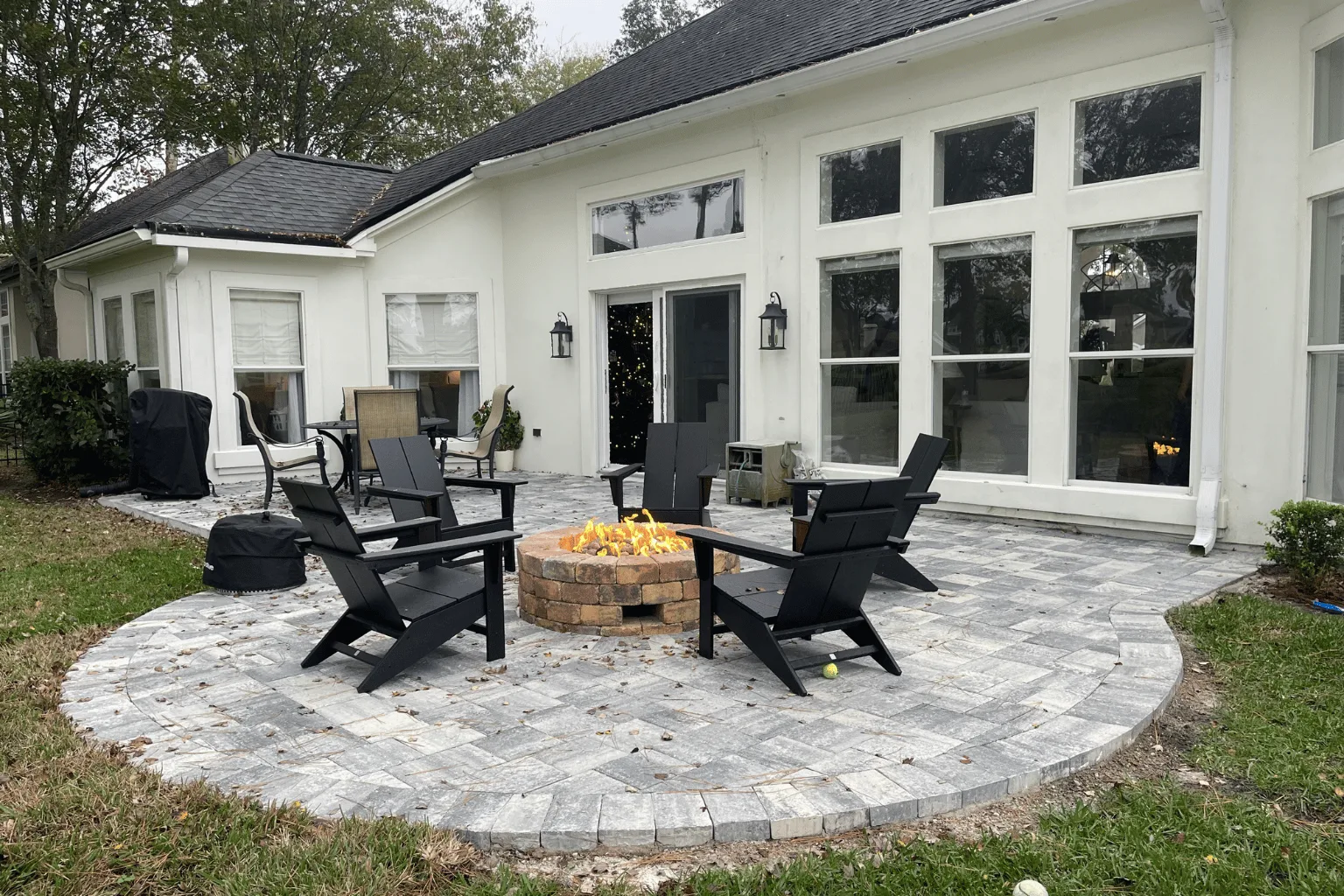
That covers the most common projects we install: replacing a cracked concrete patio with pavers, adding a new paver patio off the back of the home, installing a freeform patio with a fire pit and seating walls under a code-defined height, building paver walkways and courtyards, and similar surface-level hardscape. In Duval, St. Johns, and Clay counties, these projects go in without a permit in nearly every case.
When a Permit Is Required
The permit line gets crossed the moment a project adds a structure or modifies how the site drains. Specifically:
- Pergolas, gazebos, or any roofed structure over the patio. Permanent vertical structures always require a permit and sealed engineering — see our pergola permit guide for the full breakdown.
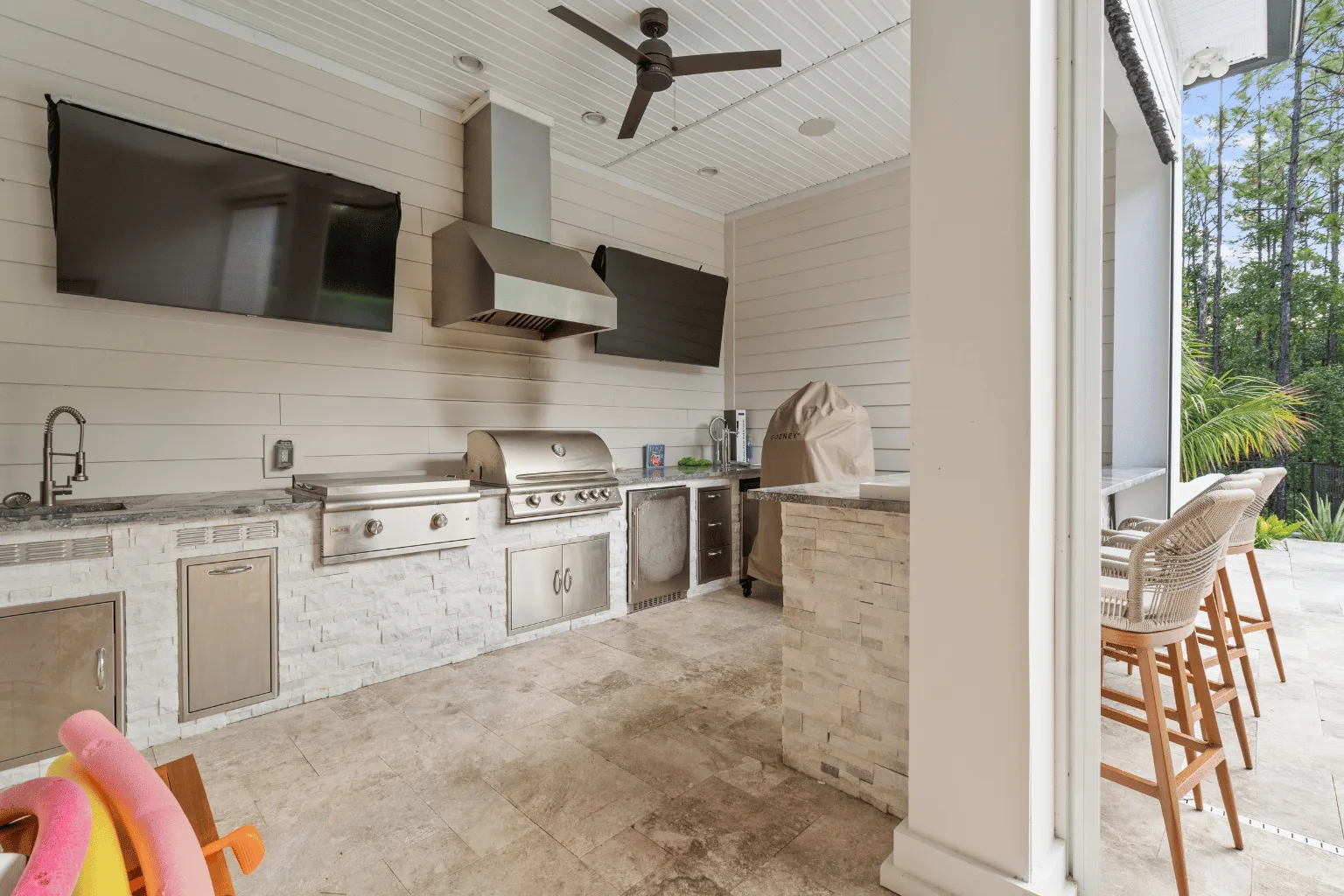
- Outdoor kitchens with gas, water, or electrical. Any plumbing, gas line, or wired electrical connection — including a gas line for a built-in grill — requires the corresponding trade permits and inspections.
- Retaining walls over the height threshold.Most Jacksonville-area jurisdictions require a permit and engineered drawings for retaining walls above 4' high (sometimes 3' if there's a surcharge load above the wall). Decorative seating walls under 2' are exempt.
- Fire pits and fireplaces with gas hookups.The fire pit itself usually doesn't need a permit; the gas line to it does.
- Patios that materially change site drainage.Large patios that expand impervious surface or redirect stormwater onto a neighbor's property or off the building envelope can trigger a stormwater review, especially in HOA communities.
- Pool deck work in some jurisdictions. Resurfacing a pool deck with pavers is usually treated like a patio (no permit), but if the work touches the pool shell, equipment pad, or deck-pool transition it may require a permit. We confirm this per-project.
HOA Approval Is Almost Always Required
The other piece most Jacksonville homeowners overlook: HOA review is nearly universal in deed-restricted communities, and it's separate from the county permit process. If you live in Nocatee, Coastal Oaks, Ponte Vedra Plantation, Marsh Landing, Queens Harbour, Plantation Oaks, or one of the other master-planned neighborhoods around Jacksonville, your patio project needs an Architectural Review Committee (ARC) or Design Review Board (DRB) submission before work starts.
ARC reviews look at aesthetics: paver color, pattern, patio size and location, drainage direction, fence and gate impact, and how the new patio relates to the neighboring lots. Reviews typically run 2–4 weeks with a small fee ($50–$200). We submit ARC packets as part of every project in a deed-restricted community — and we run that submission in parallel with material ordering so the timeline overlaps instead of stacking.
What to Use as a Base for Patio Pavers in Florida
This is where most Jacksonville patio failures actually happen — and it matters more than the permit conversation. Florida sits on sandy, moisture-prone soil that shifts under any surface that isn't properly supported. The base under your pavers is what determines whether the patio stays flat for 30 years or starts sinking in sections within 3.
The correct base layer for a Jacksonville patio paver installation:
- Excavation to 6–10" below finished grade. Deep enough to remove organic topsoil and reach stable subgrade. Skipping this step is the single most common reason patios settle.
- 4–6" of compacted limerock or crushed concrete. Limerock is the most common base material in Northeast Florida because it's locally quarried and compacts to a dense, load-bearing layer. Crushed concrete (recycled aggregate) also works well. This layer is compacted in lifts of 2" with a plate compactor — never dumped and packed all at once.
- 1" of screeded bedding sand. Coarse, washed concrete sand (not play sand or mason sand) screeded flat for precision paver leveling.
- Edge restraints.Plastic or aluminum edging installed at the patio perimeter and pinned with 10" spikes — this is what keeps perimeter pavers from migrating outward over time.
- Polymeric joint sand. Swept into the joints, misted with water, and cured into a flexible-but-locked surface that resists weeds, ants, and erosion.
- Grading for drainage. A 1.5–2% slope (about 1/8"–1/4" per foot) away from the home is the Florida standard. Done wrong, water pools against your foundation; done right, the patio drains itself during the worst summer storm.
Cutting corners on any of these layers — undersized base, skipped compaction, wrong sand, no edge restraint — is invisible the day the patio is finished and ruinous 18 months later. The base is exactly where bargain contractors save money. It's the first question to ask any Jacksonville paver contractor before signing.
How to Install Patio Pavers in Florida (The Pro Version)
Step-by-step, this is how we install a paver patio in Jacksonville — and what a homeowner attempting a DIY install would need to replicate:
- Mark the patio footprint and call 811 to locate underground utilities (gas, water, irrigation, fiber) before any excavation.
- Excavate 6–10" below the planned finish grade. Haul off the spoil.
- Compact the subgradewith a plate compactor. Confirm there's no soft spot or organic matter remaining.
- Lay geotextile fabric over the subgrade in soft fill areas (common in Nocatee and parts of St. Johns).
- Install the aggregate basein 2" lifts, compacting each lift before the next is added. Final compacted base depth: 4" for foot-traffic patios, 6" for patios with vehicular load or heavy furniture.
- Install edge restraintsat the patio perimeter and stake with 10" spikes.
- Screed 1" of bedding sand across the entire area to a precise, even depth.
- Lay the pavers from a straight edge outward in the chosen pattern (running bond, herringbone, basketweave, etc.). Tight, consistent joints; no shifting once placed.
- Cut perimeter pavers with a wet saw to fit the patio shape and edge restraints.
- Compact the field with a plate compactor and a rubber pad attachment to seat the pavers into the bedding sand without scratching them.
- Sweep polymeric joint sand into the joints, remove residue, and mist-activate with water per manufacturer instructions.
- Final cleanup and a hose-down once the polymeric sand has cured.
DIY paver patios are absolutely possible at small sizes (under 100 sq ft) with rented equipment and a willing weekend. They usually fail at scale because the base prep — excavation depth, proper compaction in lifts, edge restraints, drainage grading — is physically demanding and unforgiving of shortcuts. Most homeowners who DIY a patio over 200 sq ft end up calling us within 3–5 years to redo it the right way. The cost difference between a real install and a re-do install is almost never worth the savings.
Get a Permitted-Where-Needed Paver Patio
At Jax Pavers, every patio project starts with a free site visit where we confirm what (if anything) needs a permit, identify HOA requirements, and walk you through the base, pattern, and material options. We're licensed and insured, we handle all permitting and HOA submissions as part of the project, and we never cut corners on the base layer that determines whether your patio lasts 30 years. Explore our paver patio installation page for recent Jacksonville projects, our patio cost guide for pricing, or call (904) 445-1261 to get started.