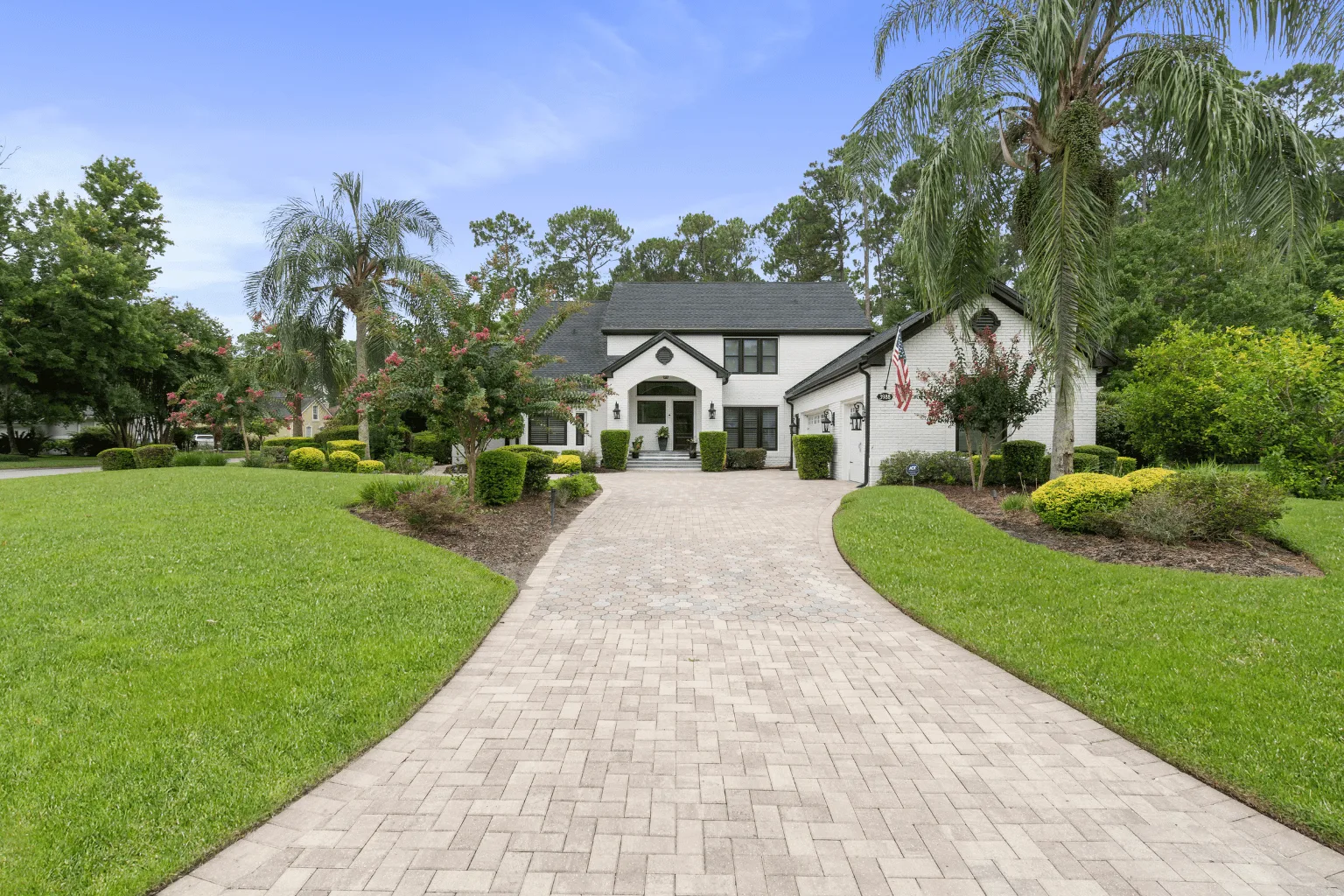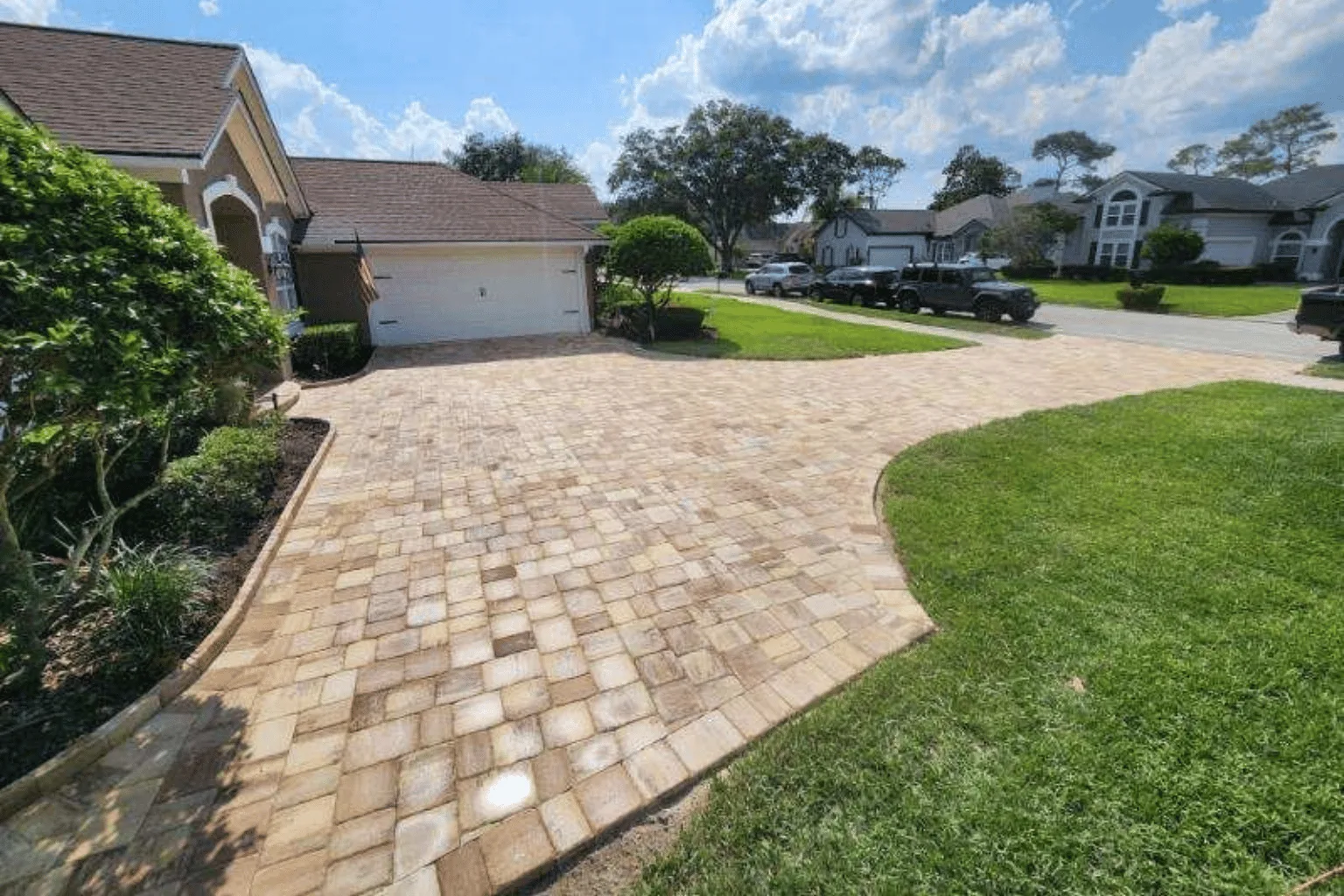
Florida driveways take a beating. Triple-digit summer surface temperatures, daily afternoon thunderstorms, salt air east of the Intracoastal, sandy soil that shifts under any rigid surface, and decades of daily vehicle weight. The honest question every Jacksonville homeowner asks before spending real money is: are pavers actually good for driveways here? The short answer is yes — when installed correctly, pavers are the best-performing driveway material in Northeast Florida. This guide covers exactly why, what makes a paver driveway hold up on the coast, and how a proper install differs from a bargain one.
Quick answer
Yes. Pavers are an excellent driveway material in coastal Florida — arguably the best performing of any common option. They flex with sandy soil instead of cracking, drain stormwater through the joints, and individual pavers can be lifted and reset if anything ever shifts. A properly installed paver driveway in Jacksonville lasts 30+ years with minimal maintenance. The two things that matter: 60mm driveway-rated pavers (not patio-thickness) and a 6–8" compacted aggregate base.
Are Pavers Strong Enough for a Driveway?
Yes — provided you use the right thickness. Driveway pavers are specifically rated for vehicular traffic and are thicker than patio pavers:
- 60mm (2 3/8") paversare the standard for residential driveways. They're rated for passenger vehicles, light trucks, SUVs, and the occasional UPS or moving truck.
- 80mm (3 1/8") pavers are used for commercial driveways and residential driveways that regularly see heavy vehicles (RVs, large trailers, frequent service trucks).
- 40–50mm pavers are patio-grade. Putting them on a driveway is the single most common DIY mistake — they crack under a turning tire within months.
Tremron and Belgard both publish vehicular load ratings for every driveway-grade line they manufacture. A properly installed 60mm paver in a herringbone pattern distributes vehicle weight across every adjacent paver and resists the lateral creep that turning wheels apply at the entry. The system is engineered for cars; the only question is whether your contractor uses the right thickness and the right pattern.
How Pavers Handle Florida Heat
Jacksonville summer pavement temperatures regularly hit 140°F+ on dark surfaces. That heat does three things to driveway materials: it expands them, it bakes the binder out of asphalt, and it cycles them through expansion-contraction every single day. Poured concrete absorbs the expansion cycles at random crack points; asphalt softens and ruts under tire loads in peak summer.
Pavers absorb the expansion at every joint — the 1/8" gap between every paver acts as a thermal-expansion buffer that would've been a crack in a slab. That's why properly installed paver driveways don't crack across the surface the way Florida concrete eventually does. Lighter color blends — sand and ivory tones — also run noticeably cooler underfoot and reflect more UV, which matters if you barefoot from the driveway to the pool or have kids playing on the surface.
Coastal Florida: Salt Air, Storms, and Sandy Soil
Driveways east of the Intracoastal — Jacksonville Beach, Atlantic Beach, Neptune Beach, Ponte Vedra Beach — face conditions that most paver guidance ignores. Three things matter:
- Salt air corrodes metal edging. We use plastic or aluminum edge restraints on coastal projects rather than steel. Steel edge restraints rust through within 5–8 years near the ocean.
- Sandy fill soil shifts more.Beach-side and Nocatee/St. Johns lots often sit on soft sandy fill rather than native clay. We compensate with a deeper base (8" vs 6") and geotextile fabric between the subgrade and the aggregate base to prevent fines from migrating up and destabilizing the layer.
- Stormwater is relentless.Coastal lots often have high water tables and reduced drainage capacity. The joints between pavers absorb rainfall the way poured concrete can't — but the grade still needs to move water off the driveway and away from the home foundation, which is why we design every coastal driveway with a deliberate fall toward the street or a French drain rather than letting it puddle.
Hurricanes and named storms are the other coastal consideration. Paver driveways themselves are essentially storm-proof — the individual units can't be torn off the way a metal roof or loose hardscape can. What does fail in coastal storms is poorly installed edging and missing polymeric joint sand. Both are easy to do right and very easy to skip.
How to Make a Driveway with Pavers (The Pro Process)
Step-by-step, this is how a paver driveway gets installed in Jacksonville — and what makes it last 30+ years instead of 5:
- Mark the driveway footprint, call 811 for underground utility locates, and pull the right-of-way permit (most Jacksonville driveway replacements require a permit because the work extends into the street apron).
- Remove the existing driveway. Break out and haul off the old concrete or asphalt. Concrete removal typically runs $4–$8 per square foot; asphalt $2–$5 per square foot.
- Excavate 8–12" below finished grade to reach stable subgrade beneath the sandy topsoil.
- Compact the subgrade with a heavy plate compactor. Confirm no organic matter or soft spots remain.
- Lay geotextile fabric in soft fill soil areas (common near the beaches, in Nocatee, and parts of St. Johns).
- Install 6–8" of compacted aggregate basein 2" lifts, compacting each lift before the next. Limerock or crushed concrete is standard in Northeast Florida.
- Install heavy-duty edge restraints at the driveway perimeter. Coastal projects use aluminum or plastic, not steel.
- Screed 1" of bedding sand across the entire base.
- Lay the 60mm driveway pavers in herringbone or another vehicular-rated pattern. Cut perimeter pavers with a wet saw to fit the driveway shape and apron.
- Plate-compact the field to seat pavers into the bedding sand.
- Sweep polymeric joint sand into the joints, remove residue, and mist-activate per manufacturer directions.
- Final cleanup and inspection. Permitted projects get a final county inspection before sign-off.
DIY paver driveways are technically possible but almost always go wrong. The base prep alone — multiple compaction lifts, exact excavation depth, geotextile in soft soil — is heavy physical work that's unforgiving of shortcuts. The labor and equipment rental for a DIY driveway usually cost 50–70% of a professional install and produce a result that fails within years. For driveways specifically, the math almost never works.
Permeable Paver Driveways for Florida Drainage
For lots with serious drainage issues — low-lying yards, high water tables, or stormwater that consistently pools — permeable pavers are a real option. Permeable systems use larger joint spaces filled with clean aggregate (not sand) so rainfall passes through the surface, through the base, and into the soil underneath. On a properly installed permeable driveway, the driveway itself becomes part of the stormwater management system.
Permeable pavers cost more — typically 10–25% above standard paver driveways because of the specialty aggregates and the deeper, more carefully graded base layer underneath. For homes with chronic drainage problems or HOA stormwater requirements, the math often works. For most Jacksonville driveways with reasonable existing drainage, standard 60mm pavers with proper grading are the more cost-effective choice.
Pavers vs. Concrete and Asphalt for Florida Driveways
Quick comparison for 2026 Jacksonville driveways:
| Material | Cost / sq ft | FL Lifespan | Repairable? |
|---|---|---|---|
| Asphalt | $7 – $14 | 10–15 years (resealed) | Patches only |
| Poured concrete | $10 – $18 | 15–25 years (cracks) | Full replacement |
| 60mm pavers | $18 – $30 | 30+ years | Lift & reset individually |
| Travertine pavers | $25 – $40 | 30+ years (cooler underfoot) | Lift & reset individually |
For a deeper cost breakdown by driveway size and a full line-item analysis, see our Jacksonville paver driveway cost guide. Over a 25-year horizon, pavers are almost always the lowest total-cost-of-ownership option for Florida driveways — concrete and asphalt both require full replacement before pavers need meaningful intervention.
Are Pavers Good for Driveways in Coastal Florida? Final Word
Yes — and arguably better in coastal Florida than anywhere else. The conditions that punish concrete and asphalt (heat-expansion cycles, sandy soil shifts, salt air, relentless storms) are exactly the conditions pavers are designed to handle. The two things that determine whether your paver driveway lasts 30 years or 5 are the paver thickness (60mm or thicker for driveways) and the base prep (6"+ compacted aggregate, properly drained, geotextile in soft soil). Both are non-negotiable.
At Jax Pavers, every driveway we install in Jacksonville uses driveway-rated Tremron or Belgard pavers, a base sized for the soil and the load, and coastal-grade hardware on every project east of the Intracoastal. We're licensed and insured, we handle all permits, and we stand behind every install. Explore our paver driveway installation page for recent Jacksonville projects, or call (904) 445-1261 to talk through a driveway built for coastal Florida.